Sunday, October 21, 2012

The Noble Eightfold Path – Right Livelihood


Zen teacher Thich Nhat Hanh wrote,"To practice Right Livelihood (samyag ajiva), you have to find a way to earn your living without transgressing your ideals of love and compassion. The way you support yourself can be an expression of your deepest self, or it can be a source of suffering for you and others. " ... Our vocation can nourish our understanding and compassion, or erode them. We should be awake to the consequences, far and near, of the way we earn our living.”
The Heart of the Buddha's Teaching [Parallax Press, 1998], p. 10.


Right livelihood has held great significance in my life. I learned many years ago that working in a position that does express my deepest self can lead to dissatisfaction, depression, and loss of attunement with who I really am.
My first job at sixteen was working in the laundry at a nursing home.  My inability to fold fitted sheets soon led to a promotion to nursing assistant.  My grandmother and mother had both worked as nursing assistants in the same facility and were well-liked and considered to be caring and compassionate workers.  I like to think that I followed in that family tradition.  I enjoyed that job and had hoped to eventually go forward and earn my nursing degree.  My father, in a rare departure from his view of traditional roles for women, insisted that I go to a four year college and pursue something other than a two year nursing license.  There was no discussion and I rebelled by going to school for a year and then getting married.  I showed him!
It took many years for me to get back onto a career path that allowed me to express my desire to be of service to others. From 1981 to 1994, I worked for an outdoor power equipment company, first as an export clerk, then moving my way to executive secretary (major fail!), and then onto my ten year position as a production control specialist, scheduling assembly lines and support operations.  It was a bad fit that led to risky and unfulfilling relationships and addiction.  I was also aware that the products sold by this company were being used in ways that harmed the environment (loss of significant amounts of the Amazon rainforest) and production workers were being treated poorly.  I was often taken to task when I raised the issue of the impact that long periods of overtime would have on families and was told that I was not to worry about individuals but about numbers. 
I was able, however, to take advantage of the tuition reimbursement program offered by the company to finish my undergraduate degree and eventually use my retirement fund to finance my graduate studies in counseling.  When I finally was able to move from a job that only fed, clothed, and housed me to a career that fulfilled me, I was able to access that deeper part of myself that finds great satisfaction in being of service.  I knew when I left that job that I wanted to dedicate my life to helping other women through significant transitions in their lives, be it recovering from addiction or finding safety.   I find that I am at my best when I am in a role that allows me to support others in a way that encourages their growth and healing. 
At times, when someone asks if what I do is too traumatic or stressful, or if the possibility of funding cuts could impact my employment, and if I should find something else, I know that right now this is where I belong, that what I do is the right livelihood for me.

Saturday, October 13, 2012

The Eightfold Path - Right Speech


This is the first in a series on the 8 Limbs, otherwise known as the Nobel Eightfold Path.  I have chosen to write about the ones that resonate with me the most and today I am thinking a lot about the path of Right Speech.
In cultivating right speech it is very important for me to release my attachment to being right.  That looks strange as I type it, but it is true.  Many times right speech is interpreted as only speaking the truth and exercising freedom of speech.  However, I cannot always be certain that what I say is true and it may only be true for me.  How I relate my truth becomes very important.  Sometimes it comes down to asking myself would I rather be right or would I rather be kind.  I don’t need to express my opinion every time I have one. 
During these highly charged political times there are plenty of people who are expressing their opinions and debating the issues of the day.  People who have the opposite opinions on matters of policy than me are not necessarily wrong; they are looking at the issues from where they stand, from where they live, from their experiences.  By speaking their truth they may seem in total opposition to my truth.  So what is right speech?
“Right speech is abstaining from lying, from divisive speech, from abusive speech, & from idle chatter.”— SN 45.8
Over the past few years I have noticed that the internet has given people the freedom to say things anonymously that they probably wouldn’t say otherwise.  I have stopped looking at comments on news websites because people are choosing to use the comment areas as a place to bully.  I have also heard speech, seen comments, and viewed bumper stickers that are not only offensive, but threatening to my way of life and viewpoint.  Freedom of speech is often used as an excuse by the person who makes the statement or by the persons who do not condone the speech but remain silent. 
The following criteria for right speech comes from the Buddhas teachings to Prince Abhaya.  (Tathagata is the word in Pali that Buddha uses when referring to himself.)
 [1] "In the case of words that the Tathagata knows to be unfactual, untrue, unbeneficial (or: not connected with the goal), unendearing & disagreeable to others, he does not say them.
[2] "In the case of words that the Tathagata knows to be factual, true, unbeneficial, unendearing & disagreeable to others, he does not say them.
[3] "In the case of words that the Tathagata knows to be factual, true, beneficial, but unendearing & disagreeable to others, he has a sense of the proper time for saying them.
[4] "In the case of words that the Tathagata knows to be unfactual, untrue, unbeneficial, but endearing & agreeable to others, he does not say them.
[5] "In the case of words that the Tathagata knows to be factual, true, unbeneficial, but endearing & agreeable to others, he does not say them.
[6] "In the case of words that the Tathagata knows to be factual, true, beneficial, and endearing & agreeable to others, he has a sense of the proper time for saying them. Why is that? Because the Tathagata has sympathy for living beings."
The main factors are three: whether or not a statement is true, whether or not it is beneficial, and whether or not it is pleasing to others. The Buddha himself would state only those things that are true and beneficial, and would have a sense of time for when pleasing and unpleasing things should be said. Notice that the possibility that a statement might be untrue yet beneficial is not even entertained.
I am not perfect.  I tend to be like Joe Biden, spouting off on issues, expressing my dismay at injustices, cursing when cut off in traffic, becoming angry when my truth is opposed.  I am trying to discern when to best keep my mouth shut.  That is not always easy.
There is another aspect to right speech that has become very important to me and that is how I talk to myself.  What I say to myself can be just as damaging as what I read or hear others say.  I am my worst critic and often my worst bully.  Right speech, therefore, becomes an internal process.  I need to pay careful attention to both, as how I express myself is a reflection of what is going on internally.

Saturday, October 6, 2012

The Four Noble Truths

To help me organize my thoughts around the Buddha's Four Noble Truths and the Noble Eightfold Path I am starting a series of posts that outline what I have learned.  Take what is of value to you and ponder the rest with an open mind and heart.


The Four Noble Truths
1.       There is the existence of suffering
2.       There is the making of suffering
3.       There is a way out of that suffering
4.       There is a specific path to restore well-being called The Noble Eightfold Path.

 .
Avoiding Suffering . . . . .
There is suffering.  Who can deny it?  I have known people who have tried their hardest to avoid it, but truth be known it becomes even more difficult when one is trying to avoid it.  Whenever I got into trouble as a teenage or even as an adult, my mother would quietly say to me “I am not going to tell your father.”  The message I got was that the world would end if my father found out so therefore it is best to keep him in the dark.  This meant that my mother suffered in silence and I didn’t get any support from my parents when I was struggling.  When something happened that my mother couldn’t avoid telling my father, then, yes, all hell broke loose.  I often wonder if it was because he had been sheltered from so many of my past failings that he hadn’t had a chance to develop an understanding that I was a flawed individual who was going to disappoint him sooner or later.
I knew a woman who said that it was important to avoid “dark” things.  She only wanted to know about the good in the world, refusing to read bad news or talk about things she found disturbing, such as mental illness or violence.  I honored that in her, but found that I was not able to talk to her about a lot of things in my life.  I work in a profession where I am exposed to the impact of domestic violence, sexual assault, and child abuse every day.  Her avoidance of anything to do with the suffering in the world protected her but left me in another situation where I was unable to discuss the pain I felt when I heard a story or even the joy I felt when I was able to connect with someone with severe mental illness.

Embracing suffering . . . .
In our attempts to avoid suffering in the world we can forget that we are all inter-connected by virtue of our heritage as human beings and residents of the Earth.  We all contain the same elements and share the same experiences.  Our viewpoints may differ so it remains very important to remember that on a very deep level we are all connected and interdependent upon each other.  By exposing ourselves to others’ suffering we are also removed from the isolation that we feel when we experience our own suffering.  This is illustrated in Phillip Moffitt’s (2012) description of the Buddhist parable of the mustard seed in his book, Emotional Chaos to Clarity.
          “When a life has been lost or great physical or mental damage done, there is no going back; there is only going forward.  You hold on to a personal claim because of what you lost, you assume the identity of the victim.  It may see right and proper, but oftentimes it is just another form of self-imprisonment.  In the parable of the mustard seed, a distraught mother comes to the Buddha with her dead child in her arms, pleading with him to bring her child back to life.  The Buddha says he will do so if she can bring him a mustard seed from a household that has not known death.  The woman frantically goes from house to house, asking if they have not known death, until finally she realizes that all households have known death, and she is able to accept that great loss is a part of life (p. 253-254).” 
The Buddha teaches us that suffering is everywhere and that we need it.  Without it we cannot be happy.  I know that at first glance it doesn’t seem to make sense but it is true.  Would we recognize the light if we did not know what dark is?  How can we know happiness, if we have not experienced suffering? 
Before he reached enlightenment and became the Buddha, Siddhartha was living behind the palace walls not knowing he was happy.  He was in a state of comfort that was consistent and satisfying.  It was not until he left the palace and saw the suffering of the world that he was able to contrast his life and face the truth of existence.  Life is suffering and it is happiness.  They can exist apart and simultaneously.  It is like riding the waves of the ocean.  We can be on the crest and able to see clearly, grateful for all we have, and then we crash into the space between and despair the loss of the view and worry we will never come out of the dark trench. 
When I realized that my attachment to staying on the crest of the wave was causing me more suffering than being in the trench, I was able to view life differently and be more satisfied.  I saw both the hard times and the good times as temporary and my attachment to maintaining the good and avoiding the bad as causing more suffering.  A Buddhist teacher once drew a formula on the board that illustrated the point.  Suffering X Resistance to the Suffering = Pain.  The more I resist, the greater my pain. 
In his book, Dancing with Life, Phillip Moffitt, taught me that the best way to manage my attachment is to keep an eye on the flame of my emotions.  If my emotions flare up, I know that I am attached to an outcome, an idea, a viewpoint, or a person, place, or thing.  My intention becomes keeping my flame low enough to feel passion and compassion, but not so high as to flare up and burn myself out with the intensity of attachment.  I am not perfect.  Politics, injustice, and fear of loss can add fuel to my flame very quickly.  However, through mindfulness of my reactions I can bring that flame back down to a point where I may be less likely to engage in unhealthy behaviors that damage my health and peace of mind. 

Over the next weeks I will be writing on the Noble Eightfold Path.

                “Wherever the Noble Eightfold Path is practiced, joy, peace and insight are there.” (Mahaparinibbana Sutra, Digha Nikaya, 16.
                The Eight Limbs are:
                Right View
                Right Thinking
                Right Speech
                Right Action
                Right Livelihood
                Right Diligence
                Right Mindfulness
                Right Concentration


Sunday, September 23, 2012

Crunchy Granola . . . . . Sweet!!


I love Greek yogurt.  I love it so much that I try to find as many things to eat with it as I can.  Today I decided I need to make some granola.  I searched around, reviewed some recipes, asked friends, and came up with the following.  It is very important that the song at the bottom of the page be played sometime during the making of the granola.  In fact, it is almost critical if you are over the age of 50.
I made this in two large batches.  You can cut it in half for one large baking sheet or 3.5 cups of granola.  I like to cook in bulk so I made two batches of 7 cups and added different things to each batch.
Preheat oven to 325 degrees.
Mix all the dry ingredients:
2 cups of rolled oats (Bob’s Red Mill)
½ cup of chopped nuts (I used pecans)
6 tbsps of pumpkin seeds
4 tbsps of sesame seeds
¼ tsp  salt
1 ½ tsps. Cinnamon
6 tbsps. Ground flax meal  (Bob’s Red Mill)
Mix the wet ingredients in a separate bowl:
6 tbsps of maple syrup
6 tbsps of unsweetened applesauce
1 ½ tsps. Vanilla ( I always use real vanilla – it is well worth it).
1 tbsp. of light oil (not olive)
Combine wet ingredients with dry and mix thoroughly.
Spread over two baking sheets lined with parchment paper.  The parchment paper is important because it soaks ups any oil and keeps your granola from oven frying. 
Bake for 20-25 minutes stirring every five minutes (you can clean the kitchen, vacuum, do laundry, and dance in the minutes between stirrings).  I knew it was almost done and all dried out when my glasses stopped steaming up each time I opened the oven.
Pour the granola into a shallow pan or bowl and let it cool completely before adding other ingredients.
I added dried blueberries to one batch (right) and a mix of dried cranberries, golden raisins, cherries, and blueberries (left) that I found at Ocean State Job Lots to the other. 
Yummy!!


Sunday, September 16, 2012

Some Thoughts Reading and Writing on a Cool Sunday Morning


Cool Sunday mornings seem to lead one to contemplation.  There is crispness in the air that relieves a significant amount of brain fog and creates a desire to find something creative and inspiring to fill the day.  It may be finding just the right piece of poetry, an essay that touches the soul, or looking up to see where the sunlight hits the edges of the leaves as they are wind tossed.
I never know what these days will bring.  I want to do more than I feel capable of at the moment.  My spirit wants to climb a mountain, paddle down a river, or ride a horse across a field.  My body wants to crawl back in bed under warm blankets with a hot water bottle and a furry cat.  My travels these days seem to be limited to where books can take me.  Right now I am living in India during the time of the Buddha.  Last week I was in Albania, Syria, and Turkey at the time of the genocide of the Albanian people. For most of July I was in Boston and its surrounding areas solving crimes with Rizzoli and Isles.  This coming week I am planning on going to the mythical land of Westeros.  I will be coming late to that party.  I haven’t read Game of Thrones yet for the same reason I never did heroin.  I am afraid I would like it too much.
This next week I am physically traveling to New Orleans for a conference.  Unfortunately that means that most of my time will be spend in a hotel conference center.  I hope to arrive early enough to be able to take a walk along the river and maybe to the French Quarter.  The New Orleans I want to see doesn’t really exist, though.  I want to walk through graveyards and visit a voodoo queen.  I want to dress in red and attend a mulatto ball and walk the streets with the characters from Isabel Allende’s Island Beneath the Sea or see one of Ann Rice’s vampires in the shadow of a cathedral. 
Reading has been both a blessing and a curse in regards to travel.  I went to England in 2005 and realized the London I wanted to visit was long gone, the blood of Anne Boleyn and Henry IIIV buried beneath the double decker buses and Mark and Spencer’s.  In 2007 I was able to see enough of Tibet to get the feel of what it must have been like to live there before the Chinese occupation, but Lhasa was merely a ghost of its former self.  Alexandra David-Neel would be heartbroken to see the Potala palace surrounded by Chinese military and tourists shopping for Western goods in gated shops, as was I, and is the Dalai Lama.  I am so grateful to those writers who chronicled their experiences during those times so I am able to be there whenever I pick up a book.
What does that mean about these times I live in now?  Will anyone ever want to read about the experiences of a woman living in the late 20th and early 21st century?  Will they find my experiences so compelling that they would want to time travel here and be a part of this world?  I don’t know.  I can’t imagine why unless they are interested in a political environment that is so divisive that I only wish I could travel into the future to see how this all ends up.  Or do I?  It is frightening.  Or would that glimpse into the future give me the hope I need?  Would a poor woman, black or white, from the world of the American south in 1840 wonder at my complaints and tell me to get a grip and appreciate that I am able to make choices that they never had? 
I guess that is what reading does.  It gives another perspective.  It may be fiction, fictionalized history, or one person’s view and interpretation of an era.  There is no real knowing.  It is just the reality of the individuals and the expression through the lens of their point of view. 
On this Sunday morning, that is what I contemplate.  My reality changes from one moment to the next.  My history will only be known by me and may be interpreted by others, but no one will truly know my story.  When I do tell it, I will only tell what I want known, what I feel is of value, and I may leave out bits and pieces in order to make myself look better or tell it all in order to explain all of who I am.  But then who would really be interested?  It doesn’t have to be everyone, just enough people who want to know what it was like to be someone like me in this time, at this place.  But it will only be my story.  No assumptions should be made that my story is the same as any other woman during this time in history.  It’s just mine and even my viewpoint changes from time to time, making my story different on one Sunday morning than it would be on another.

Saturday, September 15, 2012

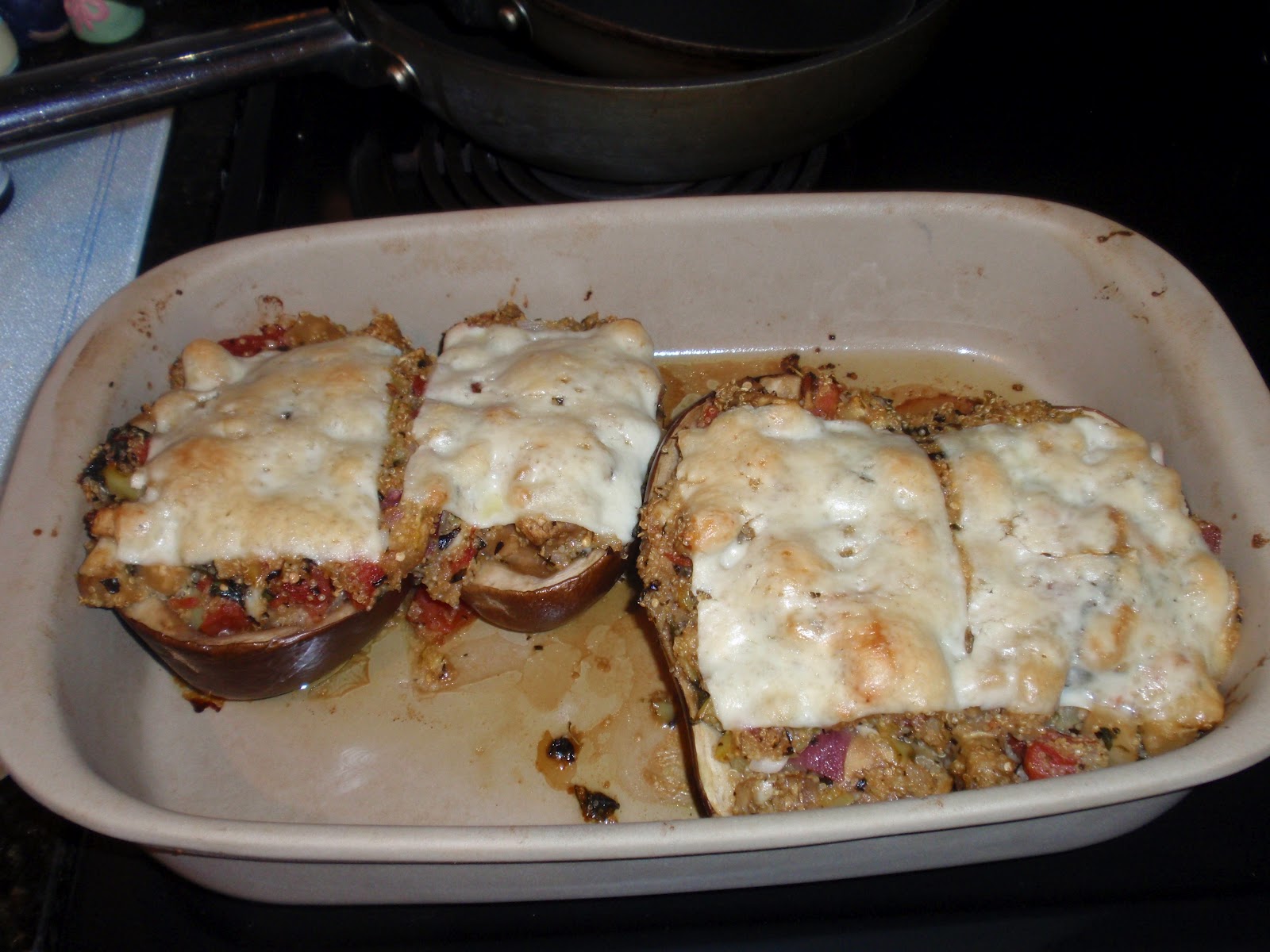
Linda’s Stuffed Eggplant with Quinoa and Asiago Cheese


Today was the first day that I felt like starting up the oven and baking something healthy and delicious!


2 medium eggplants
3 tbsps of olive oil
Fresh oregano
One medium onion - chopped
4 large cloves of garlic - minced
1 large green pepper diced
1 medium bunch of swiss chard
1 can of Italian style dice tomatoes, drained
½ pound of Asiago cheese
1 box of Nature’s Early Choice Quinoa – mushroom and vegetable medley – cooked according to package instructions.
Cut eggplants in half and scoop out insides leaving a half inch wall.  Sprinkle each half liberally with salt on the inside and place skin side up in large colander.  Chop the remaining eggplant and place in smaller colander, sprinkle liberally with salt.  Leave for 20-30 minutes while starting the quinoa.
When the quinoa has about five minutes left to cook start the stuffing for the eggplant.  Rinse the eggplant shells and pat dry.  Place in a large oiled baking dish. 
Rinse the remaining eggplant.
In a large heated skillet place four small cubes of frozen oregano and extra virgin olive oil (or the equivalent).  As they thaw add the onion.  After two minutes add the garlic, followed shortly after by the green pepper, swiss chard, tomatoes, and eggplant.   Simmer for just a few minutes and stir in the quinoa.  Crumble all but four slices of the asiago cheese and add to the mixture.
Fill the eggplant shells and top each with a slice of asiago cheese.
Bake at 350 degrees for 45 minutes or until the cheese is bubbly and brown.  Let it rest for a few minutes after you take it out of the oven and then enjoy.

Monday, September 3, 2012

Flying Monkeys and the "F" Word


Denial is often a wonderful way to keep from facing the distasteful facts of life, and it can often also allow whatever one is trying to avoid to grow into something that can no longer be ignored.  Sort of like ignoring a small drip from a pipe until your basement is flooded.  It may be easy to do for a while but eventually you have to start bailing out the water.
That is what the past fifteen years have been like for me.  In 1997 I was diagnosed with fibromyalgia.  There were a ton of reasons I didn’t like the diagnosis.  First of all, the medical community at that time seemed to use the syndrome as a place to put things with which they did not want to deal.  Hey, neither did I.  Especially because of the second reason I didn’t like the diagnosis.  Fibromyalgia is something that has to be managed.  You can’t just take a pill for two weeks and it goes away.  Surgery doesn’t remove it or fix it.  It just hangs around like a crazy relative that decides to move in next door.
The biggest reason I didn’t like it, though, was that no matter what was happening to me it was attributed to the fibromyalgia.  Urinary tract infections, whole body aches, irritable bowel, exhaustion, poor sleep, depression, itching, and the list goes on and on and on.  I started to worry that something would start to happen in my body that wasn’t related to the fibromyalgia but it would be disregarded and put under the fibromyalgia category until it was too late.
However, now it is because of that second reason I have to put on my big girl panties and surrender to the diagnosis but not to the illness.  I need to really dedicate myself to managing it.  I don’t want to but I have to.  I am not one to manage.  I tend to let things happen.  I take pride in doing a good job, but I am one on whom the details often get lost.  It is a struggle for me to manage car maintenance and personal finances, much less a medical condition that requires that I listen to my body.  One of the reasons I don’t do diets well is all that counting of points or calories or grams or servings or whatever makes me anxious and I end up focusing too much on the food.  I am fairly mindless in my approach to life although I have been making attempts over the past few years to be more mindful.
Why am I now ready to surrender and face the facts about this?  Flying monkeys.  Yes, those minions of the Wicked Witch of the West that swoop down on unsuspecting scarecrows, pummel them to the ground and tear the stuffing out, spreading it hither and yon.  Those damn monkeys have become a regular part of my daily life and they really need to go.  I am still trying to figure out why they appear.  I had a ton of tests done in hopes that there was something wrong that could be fixed, but no.  Again, it is attributed to the fibromyalgia and most likely the related issue of adrenal fatigue. 
I know all the reasons behind why this is happening in my body.  It probably all originates from when I had third degree burns from a very hot cup of coffee I managed to pour on myself at the age of 15 months.  Some of the research on fibromyalgia says that the body does not handle pain messages well.  My neural pathways related to pain were probably screwed up when the accident happened.  Other life stressors probably haven’t helped either. 
Fortunately, over the past fifteen years there has been enough research done on the syndrome to gie it more credibility and I now feel more confident about it.  It no longer seems to be a catch all.  New information is coming out about it all the time.  I also have a doctor who knows what to do and she also manages the syndrome for herself.   I trust her.
I have just completed the first step - admitting that I have a problem.  It is not my fault, but it is my responsibility to do those things that help my body.  I need to rest when it tells me it wants to rest.  I need to exercise when I don’t want to.  And I need to eat better.  Rumor has it that sugar and white flour (why does this keep coming up?) are fuel to the fire and need to be cut out.  I also need to continue to follow through with massage and acupuncture treatments.  I can’t overdo or under do.  Moderation is a word that does not normally describe my life style.  However, it needs to.    Or else I will continue to be fighting off flying monkeys or wondering who has made a voodoo doll of my body and is poking it with needles. 
I didn’t want to share this journey.  However, I realize it is a big part of my life, but I won’t let it define me.  As I said above, I will surrender to the diagnosis, but not to the illness.